Sustainable, self-healing, smart application glue: these are just a few of the many innovations being adopted by industrial adhesive manufacturers to transform industries across the globe. But none of the innovations will have optimal use if they are not utilized for the right applications.
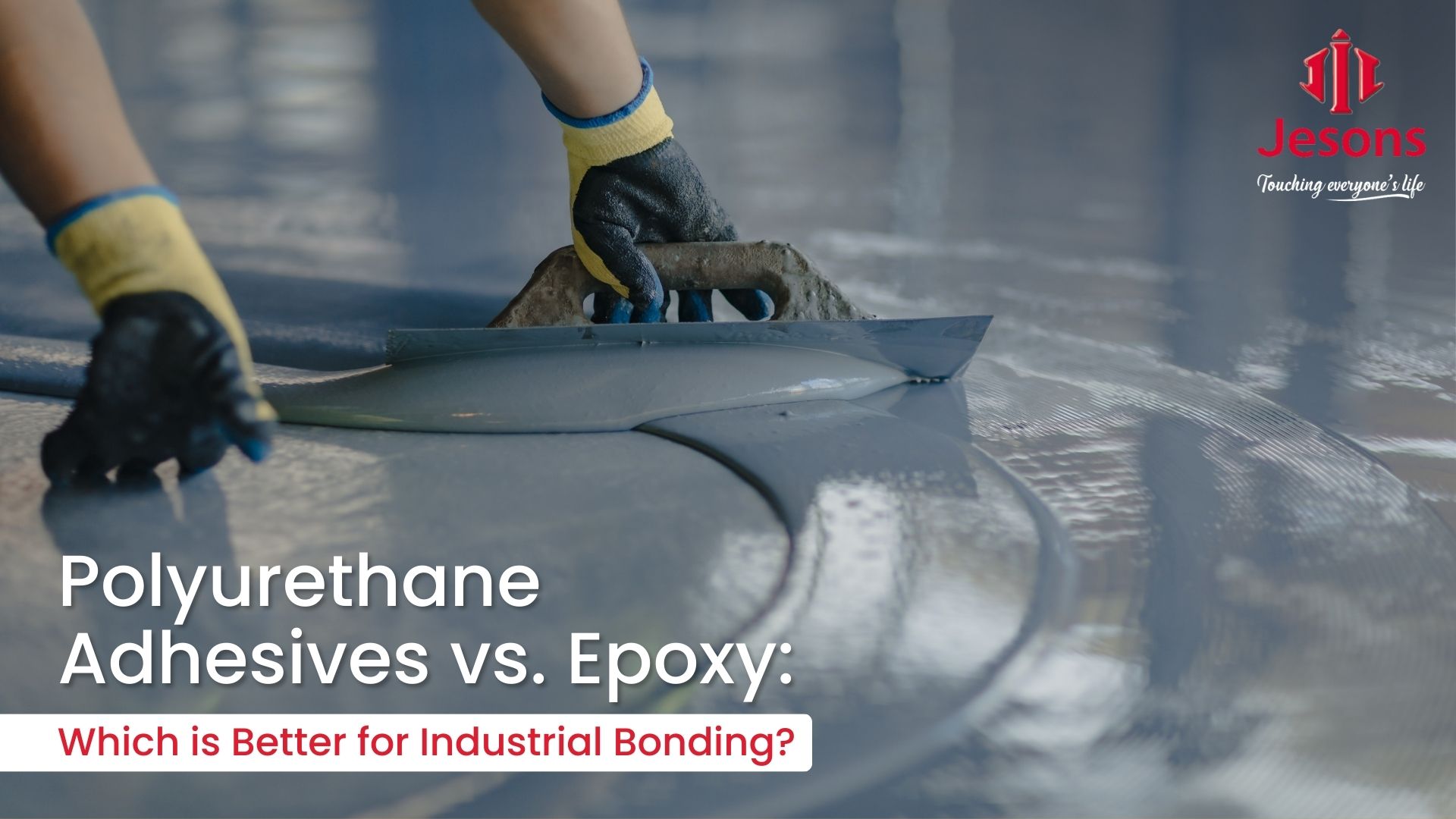
Among high-strength bonding adhesives, both polyurethane and epoxy adhesives provide unique advantages in industrial applications. But which one is better for your project? By the end of this blog, you will have an answer to this question as we deep dive into the composition and distinct properties of polyurethane and epoxy adhesives.
Composition and Key Features
1. Polyurethane Adhesives
Polyurethane adhesives are polymers formed by the reaction of isocyanate groups and polyols. This reaction makes PU adhesive highly flexible. With this, PU adhesives can withstand dynamic loads and movements, making them ideal for products that experience expansion and contraction. For example, PU adhesive is suitable for woodworking as wood tends to naturally expand and contract due to fluctuations in temperature and humidity.
Polyurethane adhesive manufacturers provide solutions for various industries, including medical, construction, packaging, electronics, and automotive. This adhesive resists UV rays, ensuring colour stability and maintaining structural integrity over time. This makes them suitable for outdoor applications.
Read More blog: Choosing the Right Industrial Adhesive for Your Needs
2. Epoxy Adhesives
Epoxy adhesive is a two-part thermosetting polymer adhesive composed of a resin and a hardener, which makes it strong and durable. Once cured, it becomes a rigid surface that can withstand heavy loads. This adhesive provides excellent resistance to moisture, chemicals, and temperature fluctuations, ensuring reliable performance even in the most demanding conditions.
Epoxy adhesive for industrial use can effectively bond with various substrates, including metals, glass, composites, ceramics, and some plastics. The strong adhesion of epoxy resin makes it ideal for construction applications. However, epoxy can be brittle and turn yellow by prolonged exposure to UV light.
Epoxy Vs. Polyurethane Adhesives
Factors | Epoxy Adhesive | Polyurethane Adhesive |
| Bonding Strength | Superior strength, but can be brittle | Good strength |
| Environmental Resistance | May not withstand prolonged exposure to UV radiation | Better resistance in the long run |
| Chemical Resistance | Good resistance | Not suitable for extremely harsh chemical environments |
| Heat Resistance | Good resistance | Moderate resistance |
| Curing | 24 – 72 hours | 12 – 24 hours |
| Flexibility | Forms rigid surface upon curing | Highly flexible |
| Cost | Less expensive | Expensive |
When comparing epoxy and polyurethane adhesives, there are several factors to consider:
1. Bonding Strength:
Once cured, epoxy adhesives exhibit superior bonding strength compared to polyurethane adhesives. However, epoxy adhesives can be brittle, causing cracks or bond failure under prolonged stress.
2. Environmental Resistance:
While both adhesives are resistant to weather, water, and UV light, polyurethane adhesives provide better resistance in the long run. However, when exposed to excessive moisture, polyurethane adhesives can form bubbles during application, which affects their bond strength and overall performance. Epoxy adhesives do provide resistance to UV light, but over time, some may turn yellow. This eventually affects the color stability and aesthetic appearance of the surface.
3. Chemical Resistance:
Epoxy adhesive for industrial use offers good resistance to chemicals and maintains strong bonds when exposed to harsh chemicals. Polyurethane adhesives also provide chemical resistance, but they might not perform as well in extremely harsh chemical environments.
4. Heat Resistance:
Polyurethane adhesive manufacturers formulate glue that has a high likelihood of degrading in strength after prolonged exposure to temperatures exceeding 150°C. Epoxy adhesives can maintain their integrity even in extreme heat, making them ideal for applications involving high-temperature processes.
Read more Blog: The Rise of Specialty Antiviral Adhesives: Enhancing Medical Safety and Performance
5. Curing:
Epoxy adhesives for industrial use require special curing conditions and take more time to set. For instance, some epoxy adhesives need 24 to 72 hours to become solid. On the other hand, polyurethane adhesives cure faster (12-24 hours) and require comparatively less surface preparation.
6. Flexibility:
Epoxy has a high tensile strength and forms a rigid surface once it’s set, making it less flexible upon application. Polyurethane remains flexible and resistant to impact after curing, irrespective of the expansion, contraction, or constant motion of the products. It has high shear strength and can resist twisting and bending forces.
7. Cost:
As compared to PU adhesives, epoxy adhesives are generally less expensive. But the durability and flexibility of polyurethane adhesives save money in the long run.
Both these high-strength bonding adhesives have their unique benefits and weaknesses. It’s up to you which strengths you choose to leverage for your project.
How to Select the Right Adhesive for Your Project?
Substrate Type: Assess whether the materials you are bonding are flexible or rigid.
Environmental Conditions: Consider whether your products will be exposed to moisture, temperature fluctuations, chemicals, or UV radiation.
Project Timelines: Since both adhesives have different curing times, choose the one that fits best in your timeline.
Long-term Performance: Consider the expected lifespan of your product and its long-term maintenance requirements.
With the proper application, both epoxy and polyurethane adhesives can be used effectively across industries. For instance, in the construction space, polyurethane adhesives are ideal for sealing joints and gaps in building facades and wooden structures. In contrast, epoxy adhesives can be used for structural bonding of metal and composite materials, as well as to seal cracks and joints in concrete.
Conclusion
When it comes to industrial bonding, both polyurethane and epoxy adhesives bring their own strengths to the table. Jesons Industries Ltd. helps you select the right adhesive for your project.
As a leading industrial adhesive manufacturer, we ensure that, whether the requirement is strength, flexibility, or durability, industries can access advanced adhesives for long-term reliability and high performance. Reach out to us to know more about polyurethane vs epoxy durability.
FAQs
How do I choose between polyurethane and epoxy for industrial bonding?
Which adhesive provides better resistance to chemicals?
Epoxy adhesive typically provides stronger chemical resistance than polyurethane adhesives.
Are polyurethane adhesives more flexible than epoxy?
Yes, polyurethane adhesives are more flexible and resist impact better than epoxy.
Which adhesive is better for high-temperature applications?
Epoxy adhesives typically outperform polyurethane in high-temperature applications.
What are the main differences between polyurethane adhesives and epoxy?
Epoxy adhesives provide rigidity and high strength, while polyurethane adhesives are known for flexibility and durability.