The conversation around sustainable adhesives has moved well beyond simply replacing one ingredient with another.
Today, manufacturers are under pressure from multiple directions. Regulations around emissions are evolving, customers are setting their own sustainability expectations, and brands are looking more closely at the environmental impact of the materials used throughout their products and packaging. Adhesives are part of that equation.
This has led to growing interest in water based adhesive manufacturers as well as low-VOC and bio-based adhesive technologies. However, making the transition is not always as straightforward as switching to a product labelled “eco-friendly”. Adhesive performance is closely linked to the substrate, application process and end-use environment. A more sustainable formulation still needs to do its primary job: deliver a reliable bond.
For buyers, the question is therefore not simply whether to make the shift, but how to make it without compromising performance or process efficiency.
What is Driving the Shift Towards More Sustainable Adhesives?
For many industries, reducing the environmental footprint of manufacturing has become a practical business requirement rather than a distant objective.
One major driver is the need to reduce volatile organic compound (VOC) emissions. Conventional solvent-based systems can involve higher VOC levels. This has led manufacturers to explore alternatives that can support safer handling and evolving environmental requirements.
At the same time, customers are becoming more conscious of the materials used in their products. This is particularly relevant in sectors such as packaging, furniture, and textiles, where sustainability considerations increasingly influence procurement decisions.
Water based adhesive manufacturers are responding to this shift with technologies designed to balance lower emissions with the performance requirements of modern manufacturing.
Water-Based Does Not Mean a Compromise on Performance
One of the common assumptions surrounding sustainable adhesive technologies is that improved environmental performance must come at the cost of bond strength or durability. However, some of the leading speciality chemical manufacturers like Jesons Industries Ltd. are changing the narrative.
Advances in polymer chemistry have significantly expanded the capabilities of water-based adhesive systems. Depending on the formulation, they can be developed for different substrates, processing conditions and performance requirements.
The transition, however, requires a closer look at the application.
Factors such as drying conditions, line speed, substrate absorbency and the final environment in which the bonded product will be used can all influence performance. A water-based adhesive that works effectively for one application may not necessarily be suitable for another.
This is where experienced water based adhesive manufacturers can add value. The focus should be on understanding the complete bonding requirement rather than simply replacing an existing formulation with a water-based alternative.
Where Do Bio-Based Materials Fit In?
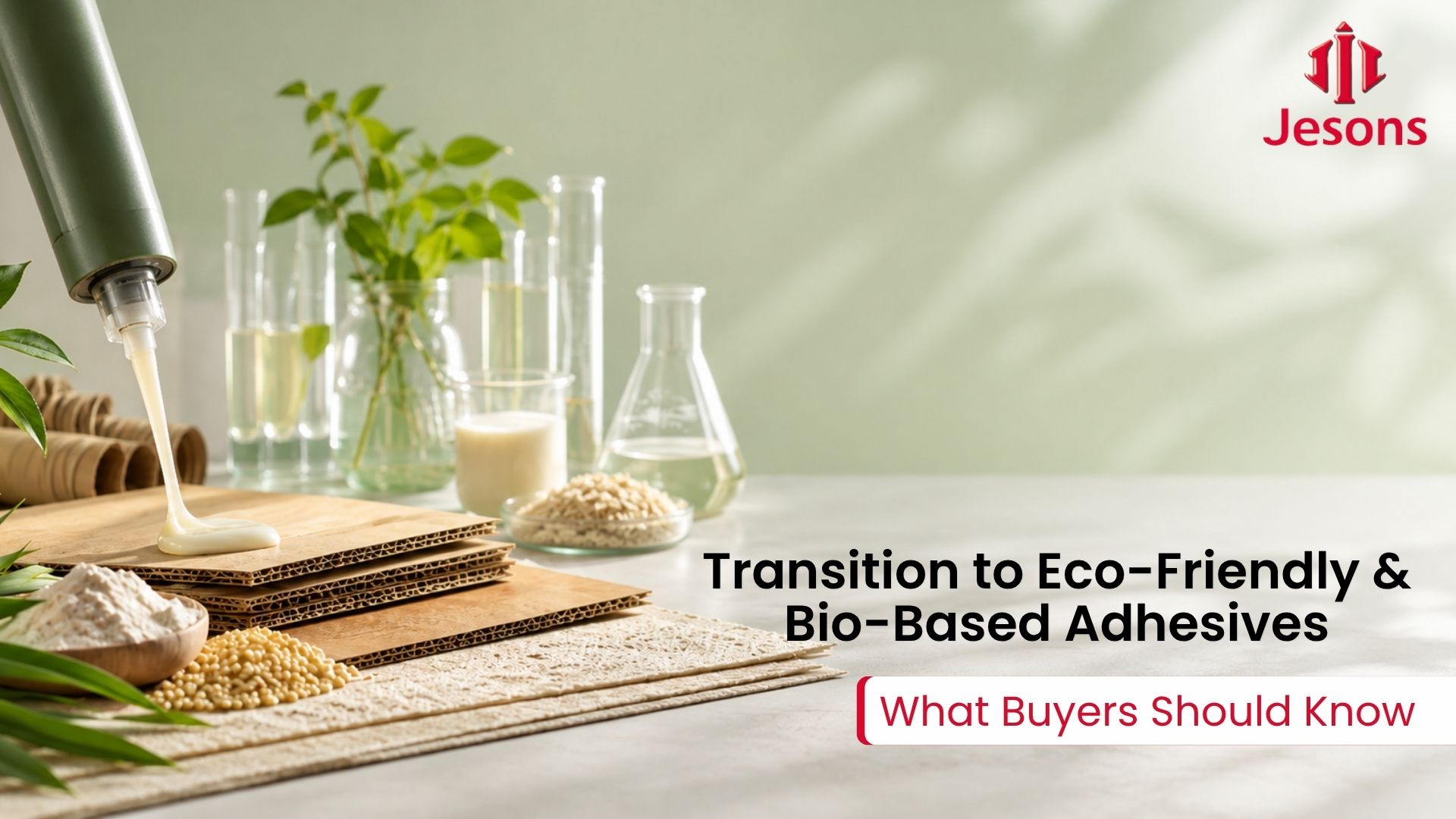
Bio-based adhesives take the sustainability conversation a step further by incorporating raw materials derived wholly or partly from renewable sources.
Their growing relevance reflects a broader industry effort to reduce dependence on fossil-based feedstocks. However, “bio-based” does not automatically mean that an adhesive is suitable for every application or that it will deliver the same properties as a conventional system.
Buyers should look beyond broad sustainability claims and ask more specific questions:
- What proportion of the formulation is derived from renewable sources?
- How does the adhesive perform under actual operating conditions?
- Are there changes required to the existing production process?
- Does the formulation meet relevant safety and regulatory requirements?
- Can the technology deliver the required consistency at scale?
The objective should be to assess sustainability alongside performance, availability and long-term suitability.
Why Formulation Matters in the Transition
An adhesive is a carefully balanced system. Changing one component can influence several others.
For example, moving towards lower-VOC or renewable raw materials may affect drying behaviour, viscosity, tack, open time or resistance properties. These changes need to be understood before the formulation is introduced into a production environment.
This is also why the role of speciality chemical manufacturers extends beyond supplying individual raw materials. Formulation expertise, testing and technical understanding are essential when developing solutions for specific applications.
Similarly, the shift towards safer and more responsible chemical systems has increased interest in materials such as APEO-free polymer emulsions (Alkylphenol Ethoxylates). APEO-free polymer emulsions manufacturers are helping meet this demand by developing technologies that align with evolving application and regulatory expectations.
The right transition is usually a process, not an overnight replacement.
What Should Buyers Evaluate Before Making the Switch?
Before introducing a new eco-friendly or bio-based adhesive, it helps to evaluate the transition across three areas.
Performance: Does the adhesive meet the required bond strength, durability and resistance properties for the intended application?
Process compatibility: Can it work with existing equipment and production conditions, or will changes be required?
Sustainability credentials: What makes the formulation more sustainable, and are those benefits relevant to the organisation’s broader environmental objectives?
Water based adhesive manufacturers and speciality chemical manufacturers can play an important role here by supporting application testing and formulation development rather than treating sustainability as a standalone product feature.
Making Sustainability Work in Real Applications
The transition towards eco-friendly and bio-based adhesives is likely to continue as industries look for ways to reduce emissions, improve material choices and respond to changing market expectations.
But a successful transition depends on more than choosing a greener label.
The most effective solutions are those that bring sustainability and performance together in a way that works for the actual application. This requires an understanding of the chemistry, the production process and the conditions the final product will face.
As one of the speciality chemical manufacturers working across polymer emulsions and adhesive technologies, Jesons Industries Ltd. continues to focus on developing application-relevant solutions that support evolving performance and sustainability requirements.