Pressure-sensitive adhesives (PSAs) are redefining the adhesive industry. PSAs offer strong bonding without the need for heat, water, or solvents, transforming how industries bond, package, and label products globally. Their efficient mechanism and versatility have made them indispensable to industrial adhesive companies, particularly as demand for clean, reliable, and versatile adhesives continues to increase.
Have you ever wondered how the PSA system works exactly? In this blog, we will explain the mechanism of PSAs, their wide range of applications, and the advantages they offer.
What Are Pressure-Sensitive Adhesives?
PSAs are non-reactive adhesives that adhere to substrates simply by applying light pressure. Since it exerts a strong folding force without activation by solvent, water, or heat, pressure-sensitive adhesive is an ideal choice for fast and mess-free applications.
Trusted by leading industrial adhesive companies, PSAs are formulated to offer the same adherence strength across various surfaces. The adhesive also provides sufficient elasticity and cohesiveness for a smooth removal process, leaving no residue.
How Do Pressure-Sensitive Adhesives Work?
When it comes to PSAs, their ability to bond mainly depends on the chemical and physical properties of their component materials. When pressure is applied, the molecules within the adhesive deform and flow to make direct contact with the substrate. This blend is achieved through intermolecular forces between the adhesive and the surface.
The degree of adherence depends on the amount of pressure used to apply the glue to the surface. Pressure-sensitive adhesive manufacturers must understand the substrate factors, including surface smoothness, energy, and contaminants, to ensure proper bonding upon application.
Types of Pressure-Sensitive Adhesives
Pressure-sensitive adhesives can be categorised into four main types, based on their distinct core adhesive components and applications. Each category further has different adhesives within it.
1. Synthetic Rubber-based PSAs:
These adhesives are popular amongst tape adhesive manufacturers.
- Composition – Styrene-butadiene (SBR) or styrenic block copolymer (SBC)
- Strength – Heat-ageing properties, aggressive tack, tailored peel strength, high versatility
- Weakness – Low-temperature resistance
2. Natural Rubber PSAs:
Considering its properties, this adhesive is more suitable for indoor applications.
- Composition – Natural rubber and tackifying resins
- Strength – Strong initial adhesion and high peel strength
- Weakness – Lack of strong resistance to moisture, high temperatures, and UV rays
3. Silicone-based PSAs:
It is a well-known type of high-temperature pressure-sensitive adhesive.
- Composition – Silicon elastomers
- Strength – Excellent performance on low-energy substrates and exceptional durability
- Weakness – Higher cost as compared to other PSAs and lacks an aggressive tack
4. Acrylic-based PSAs:
This type of PSA is ideal for outdoor applications and decorative trim.
- Composition – Acrylic monomers
- Strength – Excellent resistance to oxidation, high temperatures, plasticisers, UV radiation, and weather conditions; good clarity, colour stability, and long-term stability
- Weakness – Poor adhesion on low surface energy polymers and low initial tack
PSAs can be further classified as water-based, solvent-based, or hot-melt adhesives, thereby expanding their versatility across various industries.
These adhesives are usually formulated to form a bond at room temperature. They lose their strong adherence ability at low and high temperatures. However, acrylic and silicone-based variants are commonly developed by high-temperature pressure-sensitive adhesive manufacturers for applications in automotive and electrical insulation, where standard adhesives might fail.
Key Applications Across Industries
PSAs are used in bonding products that have everyday applications in various industries and for daily use. Here are some of the real-world use cases:
1. Packaging and Labelling:
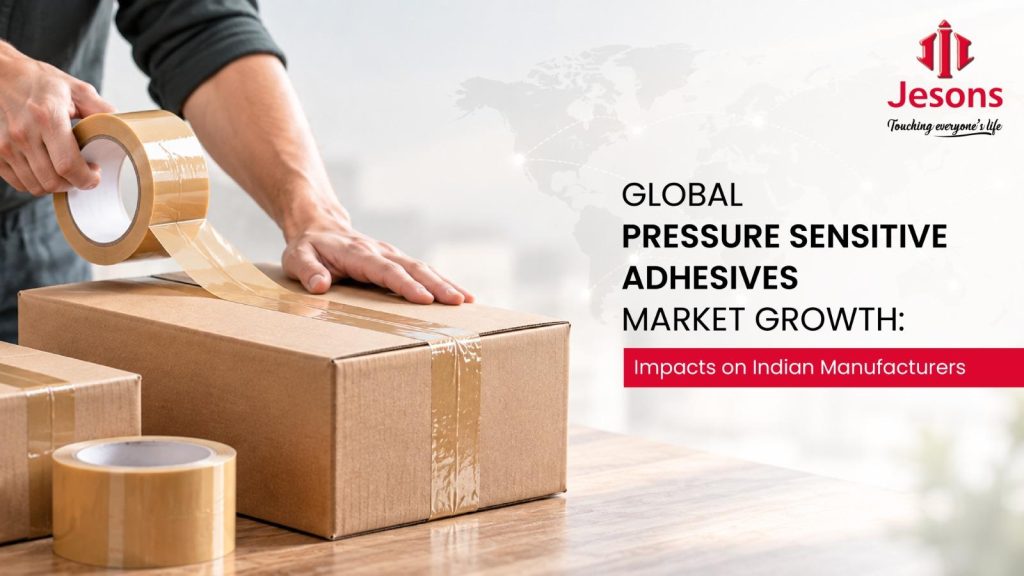
Tape adhesive manufacturers seek a reliable adhesive that can withstand both mechanical and environmental issues. With its strong bonding properties, PSAs become an ideal choice for them. Furthermore, their ability to adhere to various surfaces makes them the go-to adhesive for label manufacturers.
2. Construction & Interiors:
PSAs are easy to apply and offer long-term performance even in moisture-prone regions. Hence, they are often used in foam bonding, vapour barriers and flooring tapes.
3. Medical & Healthcare:
PSAs are used in surgical drapes, bandages, and drug delivery tapes since they don’t harm the skin during removal.
4. Automotive Industry:
In the automotive manufacturing units, PSAs can be used for emblem attachment, nameplate attachment, surface protection films, gasketing, and sealing, among other processes.
Why Switch to Pressure-Sensitive Adhesives?
Below are some of the key features of PSAs that give them an edge over traditional bonding methods –
- Ease of use
- Versatility
- Easy Removal
- Customizable Formulations
Industrial adhesive companies are increasingly focusing on solvent-free PSAs to make them safer for workers and eco-friendly. As a leading pressure-sensitive adhesive manufacturer, we at Jesons Industries continue to formulate adhesives that deliver exceptional performance in the most demanding real-world conditions.
Conclusion
PSAs have become indispensable in modern manufacturing. They offer the flexibility and performance that today’s dynamic applications demand. So, studying the science and practical applications of pressure-sensitive adhesives will continue to be essential for maintaining a competitive edge and meeting evolving consumer demands.
If you are looking for reliable, high-temperature pressure-sensitive adhesives or durable adhesives for labels, our formulations are designed to match your dynamic requirements. Contact us today!
Read More Blog: The Rise of Speciality Antiviral Adhesives: Enhancing Medical Safety and Performance
FAQs
What are the advantages of using pressure-sensitive adhesives?
Where are PSAs used in industrial applications?
They are used in various products across multiple industries, including packaging, medical, automotive, electronics, and construction.
What are the types of pressure-sensitive adhesives?
The main types of PSAs include acrylic-based, rubber-based, and silicon-based, with each offering different levels of temperature resistance, tack and durability.
How does pressure-sensitive adhesive work?
PSAs spread and bond with the substrate using intermolecular forces like Van der Waals interactions.
What is a pressure-sensitive adhesive?
Pressure-sensitive adhesive is a type of self-adhesive that forms a bond with the surface when pressure is applied.