$38,633.3 Million – this was the global market size of water-based adhesives last year. There is a growing emphasis on implementing sustainable practices across industries. From construction to manufacturing, businesses are adopting processes and solutions that are both efficient and environmentally responsible.
In line with this, water-based adhesives are emerging as a transformative solution given their ability to maintain high production quality while reducing their ecological footprint. In fact, there has been an increase in water-based adhesive manufacturers in the Asia Pacific region in 2024. Rapid industrialisation, rising e-commerce and infrastructure projects are key factors fueling the market growth.
In this blog, we’ll explain the growth of water-based pressure-sensitive adhesives (PSAs) and their ecological benefits, which go beyond the production floor.
Why are Water-Based Pressure Sensitive Adhesives Gaining Momentum?
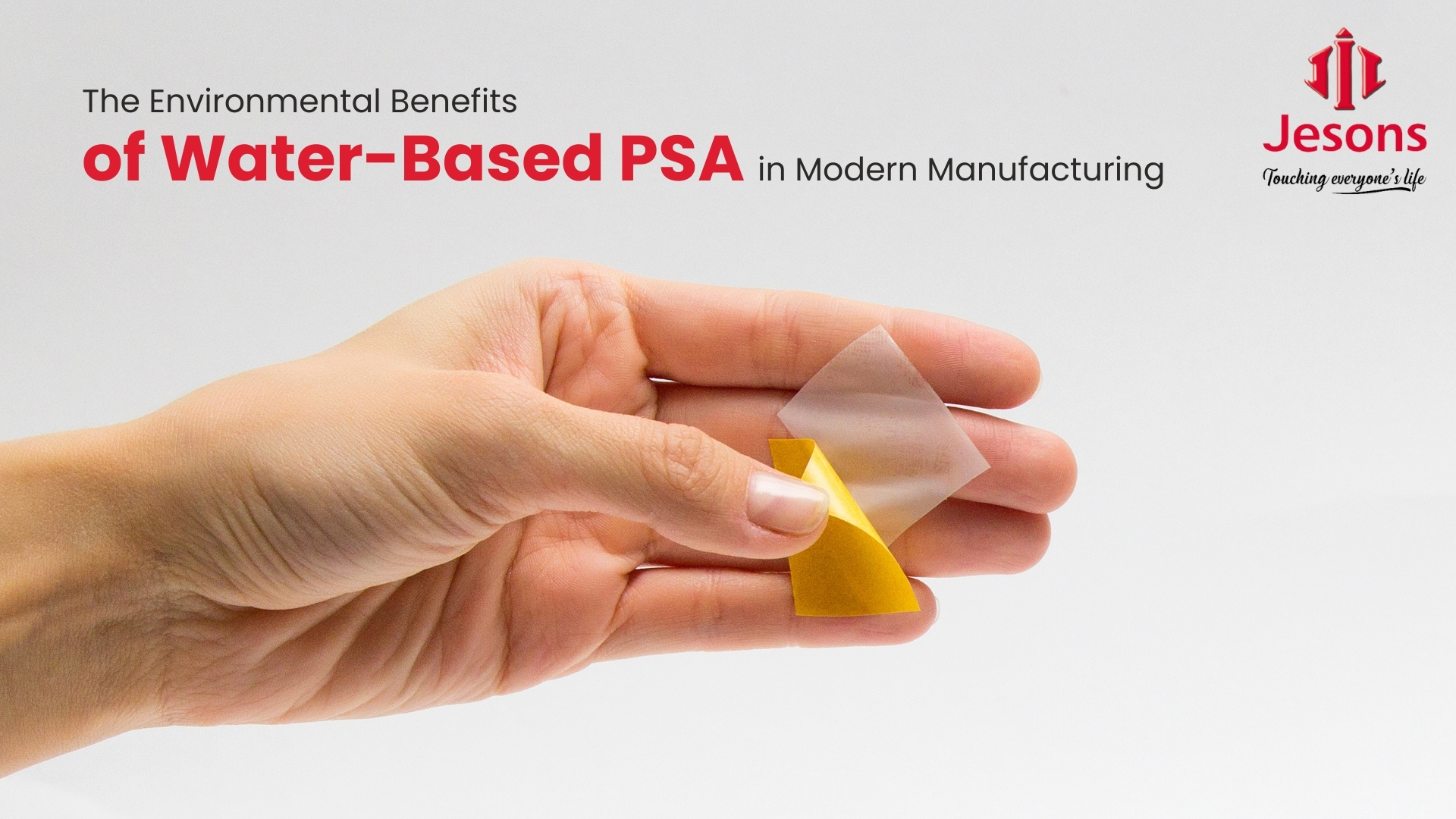
When it comes to PSAs, the polymer forms viscosity when light pressure is applied and adheres to the surface. They don’t require solvent activation or heat to form a strong bond. PSAs are widely used in the manufacturing of labels, tapes, hygiene products, and construction tapes, amongst others. Traditionally, a majority of the pressure-sensitive adhesives used solvent-based systems, which eventually led to the release of volatile organic compounds (VOCs). These compounds are hazardous to both the personal health of the workers and the environment.
To mitigate these issues, manufacturers are switching to solvent-free solutions for various lightweight bonding needs, such as paper-based products and carton sealing. These adhesives consist of less harmful components, offering comparable performance and a sustainable alternative.
Read More Blog: Choosing the Right Industrial Adhesive for Your Needs
Water-based PSAs are versatile and suitable for various fields of application, including BOPP Tapes, Protective Film, Paper Labels, Difficult Surface Labels, Pencil Glue, Battery Gauntlets, and Filmic Labels, among others.
An Eco-Friendly Alternative to Traditional Adhesives
Being able to provide cleaner chemistry without compromising performance has become a key differentiator amongst pressure-sensitive adhesive manufacturers. Let’s take a closer look at the environmental impact of water-based PSAs.
1. Low VOC Emissions:
Solvent-based PSAs use organic solvents as a carrier for adhesives, whereas water-based PSAs utilise water for this process. Traditional paints and coatings, which are solvent-based, often emit volatile organic compounds (VOCs) that contribute to air pollution and can impact air quality. As opposed to them, water-based PSAs significantly reduce the release of these VOCs.
2. Better Compliance:
Global regulations are increasingly tightening around chemical emissions and their ecological footprint. Switching to water-based PSAs is a proactive step that pressure-sensitive adhesives manufacturers can take towards easier compliance.
3. Improved Air Quality:
In manufacturing and end-use environments, reduced chemical exposure leads to cleaner air on the production floor as well as in residential spaces. It also creates safer conditions for workers handling adhesives daily.
The Role of APEO-Free Chemistry in Water-based PSAs
Many water-based PSAs are made with APEO-free (Alkylphenol Ethoxylates) polymer emulsions. APEOs are traditionally used as non-ionic surfactants in conventional emulsions. But APEO emulsions are not readily biodegradable and tend to break down into alkylphenol compounds, which are toxic to aquatic life.
By using APEO-free emulsions, pressure-sensitive adhesive manufacturers reduce their environmental footprint and align with global green chemistry principles. From the production floor to everyday packaging, the impact of APEO-free PSAs extends across the value chain.
Related to eco-friendly chemicals, but not directly tied to PSAs, so you can use it as an explanation that water-based PSAs are made from APEO-free emulsions.
How Do Defoamers Enhance the Sustainability of PSA Systems?
Some components of water-based PSAs tend to produce bubbles which have a lasting tendency. The rapid mixing process further contributes to the formation of foam. This can disrupt the application, reduce coverage, affect the adhesive’s properties, lead to waste and eventually reduce the quality of the end-product. In water-based PSAs, it is also quite easy to cause shrinkage and fish eyes. PSA manufacturers need to ensure the elimination of the foam or prevent the generation of foam at its source by using defoaming agents. The right defoamer for coatings can:
- Enhance coat uniformity
- Reduce curing and drying defects
- Minimise material wastage
- Utilise less energy
- Enhance surface adhesion
Mineral oil defoamer is generally used in water-based pressure-sensitive adhesives. This enhances the performance of the adhesives and contributes to resource efficiency and environmental protection.
Read More Blog: A Roadmap for Progress: Driving Sustainable Innovation Through Collaboration
We partnered with San Nopco, a Japanese expert in additives, for the distribution of high-end defoamers for coatings, along with a range of additives. These defoamers shorten production cycles and lead to better finishes, fewer defects, and higher output.
Engineering Sustainable Solutions for the Future
PSAs are used in everyday items from stationery labels to tapes on hygiene products. Choosing adhesives from trusted water-based adhesive manufacturers ensures that performance never comes at the cost of the planet. As a leading pressure-sensitive adhesive manufacturer, Jesons Industries Ltd. has proactively invested in R&D to create water-based adhesives that support circular manufacturing. Being a trusted APEO-free polymer emulsions manufacturer, we are committed to offering customised water-based PSAs that are safe across the production cycle.
Our PSAs are designed to adhere to various substrates, including metal, glass, paper, and plastic, ensuring strong bonding in multiple applications. We offer customised adhesive solutions to help with specific industry needs. Our experts work closely with the clients to develop tailored formulations for their unique applications. These formulations offer the same levels of adhesion, durability, and film-forming ability as that of traditional emulsions, without compromising on safety.
Conclusion
The water-based adhesives market size is projected to reach $66,595.2 million by 2030. With such promising growth comes great responsibility towards the planet and the future generations. The journey to sustainable manufacturing is built layer by layer, especially when it comes to coatings and adhesives. Non-toxic PSAs are a powerful step in this process, providing a more responsible solution for modern manufacturing. As a trusted water-based pressure-sensitive adhesive manufacturer, Jesons Industries takes pride in being an integral part of this revolution for a greener tomorrow.
Contact us to explore our eco-friendly PSAs tailored for your unique needs.
FAQs
Are water-based pressure-sensitive adhesives effective in heavy-duty applications?
How do water-based PSAs compare to solvent-based adhesives?
Water-based PSAs offer similar adhesion strength to that of solvent-based adhesives but with the added benefit of low VOC emissions.
What are the environmental advantages of using water-based PSAs?
Water-based PSAs release fewer volatile organic compounds (VOCs), making them a safer alternative.